Konstutställning: MICHAEL PERLMUTTER, Fotografi – Filateli: Ett av många gratis evenemang på www.gratisistockholm.nu
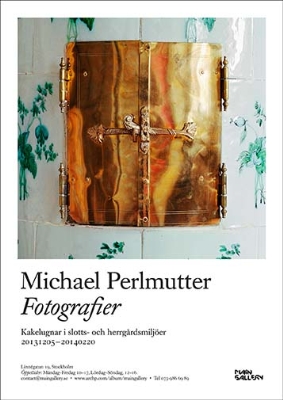
Michael on Rootsis elav ameeriklane, arhitektuurifotograaf, kes näeb siinset kultuuri veidi teisest vaatenurgast. Fotonäitus on Rootsi 18.sajandi kahhelahjudest. Kahe kunstniku foto pöhjal on Rootsi Post välja andnud ka margid, sellest siis näituse seos filateeliaga.
Näitusel olevad tööd on välja antud August-preemiaga hinnatud raamatus "Rootsi kahhelahjud: 1700 aastate Marieberg'i ja Rörstrand'i toodang" , tekst Susanna Scherman.
Näitust saab vaadata: Main Gallery, Linnegatan 19, Stockholm
Aeg: 5 detsember 2013 - 13 veebruar 2014
Tahan näitust ise pyhade ajal vaatama minna, siis ehk pikemalt.
Väga tore ja pöhjalik tekst on autorilt, räägib Michael Perlmutter :
"Americans are often fascinated with European history, its royalty, aristocracy, old world culture … things we don’t have at home. For my part, however, as an expat American living in Sweden, my engagement with Sweden’s past comes from a different point of view. I am not much of a traditionalist by temperament, usually preferring the new and forward-thinking to the tried and true.
But there is something about eighteenth century Swedish design that captures my imagination, its pared-down elegance and grace, a design ideal that has survived shifting trends through all the succeeding centuries, and that remains remarkably well-preserved in many places throughout the country.
As an architectural photographer from another culture, my position as an outsider means I process Sweden’s cultural heritage differently than a native would. And I imagine my way of seeing it, through the lens, arises from a different set of cultural filters as well. Tile stoves are part of every Swede’s upbringing. Images of tile stoves from previous eras conjure childhood memories: my grandparents had one just like that! By contrast, I had never heard of tile stoves, never seen one, or even an image of one, until I came to Sweden, when I was in my thirties, back in 1989.
This kind of foreigner’s detachment, I think, has affected my approach to the subject. Freed from associations, I viewed the tile stoves more as aesthetic objects in and of themselves, independent of a narrative. In the process of photographing, I responded to the beautiful forms, the rich colors, the clarity of the glazing, the brilliant integration of the stoves with the interior design – all packaged in an efficient heating source that would make the Nordic winters not only bearable, but comfortable as well.
The architect in me was fascinated by the marriage of form and function; the photographer in me sought endlessly to bring out the essence of these objects in the most revealing and sensual way I could.
The large-format view camera was the means to this end. The slow, deliberate nature of operating view cameras fosters a very careful, controlled approach to the making of each image, demanding time and patience, a melding of technology with a sensitivity to the subject and the character of the ever-changing light. Everything in each image is razor-sharp, vertical lines are kept parallel, color saturation is maximal, all contributing to give the impression that you, the viewer, can almost step into the image, to enter another world in all its richness and delight, like Alice through the looking-glass. The large prints in this exhibition were produced to magnify this feeling even more.
In my work I am more interested in capturing what is, rather than imposing changes to things or augmenting what I see with my own personal interpretations. The aesthetic I pursue arises not out of staging a scene, bringing in new or unexpected elements, dramatizing the lighting, applying filters, or anything else that adds. Instead it comes out of the process of seeing what is before me, intensely, and applying all my technical know-how to get others to also see what I saw, just as intensely.
That Sweden Post has selected two of my images for new postage stamps comes for me as a kind of affirmation of my approach, and I feel very honored to have my work recognized in this way. I also get the bonus of seeing my photography interpreted by a highly skilled engraver, who has the task of making each image work in a tiny stamp format without losing the original’s essential character.
The release of the stamps became the impetus for this exhibition, which at once celebrates photography, philately, tile stoves and eighteenth century interior design. With my work issued as stamps, I feel privileged to be a small part of the long lineage of stamp production in Sweden. This is one tradition I gladly embrace."

No comments:
Post a Comment